

A fractured mounting bolt can be blamed on material strength when the actual sequence began with lost compression, interface movement, and cyclic bending. Cleaning the broken surfaces or retightening neighboring fasteners can erase evidence of that sequence. I investigate bolts by preserving the assembly state and testing competing mechanisms. This article explains fracture evidence, material and process review, representative reproduction, and the validation required before a corrective specification is released.
A bolted connection stores preload and then responds to operating loads through its contact and structural stiffness. Failure analysis begins by reconstructing that intended behavior. I identify how the external force was meant to pass through the connected members, what compression was required, and whether the bolt was expected to experience tension, shear, bending, or a combination.
The failed condition is the end of a sequence rather than necessarily its beginning. A contact may first settle, then slip, then place the bolt in cyclic bending. A thread may deform before complete stripPing. A crack may grow under repeated loading before the remaining section fractures under a later event. The final separation therefore needs to be interpreted alongside the preceding assembly and service evidence.
Reconstruct the intended connection geometry, material condition, assembly process, and functional load path.
Preserve the observed fastener, mating components, contact surfaces, and positional evidence before intervention.
Identify candidate mechanisms consistent with the fracture, deformation, and operating history.
Select examinations capable of distinguishing those mechanisms without unnecessarily destroying evidence.
Compare the findings with traceable material, finishing, assembly, and service records.
Validate the proposed mechanism and corrective change using representative analysis or testing.
Different failure mechanisms can occur together. Preload loss can enable fatigue, and corrosion can contribute to crack initiation while movement damages the coating. A final overload region can appear on a bolt whose earlier life was governed by progressive cracking. I avoid forcing all observations into a single label before their sequence has been established.
The absence of a visible crack in neighboring bolts does not establish that they retain their original capacity. They may share the same finishing history, overload event, or movement exposure. Conversely, a shared batch alone does not prove a common cause if the failed location experienced a different load path. Both configuration and material identity must be considered.
No technical standards or verified specification appendix were supplied. Examination methods, sampling requirements, applicable clauses, and numerical acceptance limits require verification before specification.
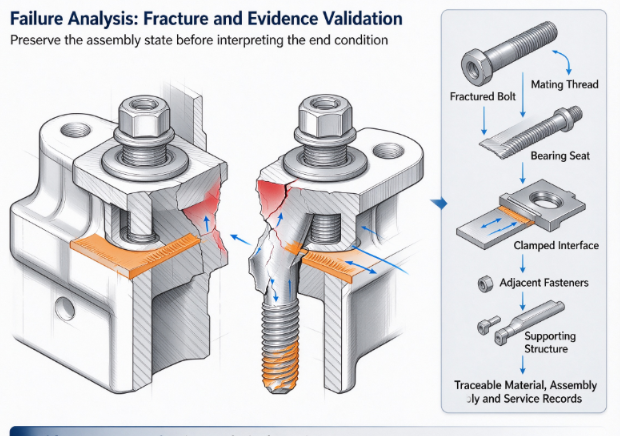
The investigation must include the parts that can explain the load history. A broken bolt alone may not reveal whether its support moved, its mating thread deformed, or its bearing seat settled. I preserve the associated Nut, washer, plate, housing, and any retained fragment with their orientation and location recorded.
Material descriptions must be tied to the actual specimens. A catalog description or unrelated certificate cannot establish the failed part's heat treatment, hardness, coating history, or dimensions. The investigation record should identify which properties were measured, which were documented, and which remain uncertain.
| Component | Material Spec | Function | Failure Risk if Compromised |
|---|---|---|---|
| Failed bolt and retained fragments | Verify actual material, hardness, heat treatment, and finished geometry. | Carry preload and service demand; examine fracture origin and deformation. | Loss of the connection and loss of diagnostic evidence. |
| Mating nut or internal thread | Verify specimen material and effective engagement. | React bolt tension; examine stripping, deformation, and fit. | Thread failure can initiate or conceal the separation sequence. |
| Bearing seat and washer | Verify material, support geometry, and surface condition. | Transfer compression; examine indentation and contact patterns. | Settlement or edge loading changes bolt demand. |
| Clamped interface | Verify substrate, coating, and contamination state. | Provide the intended load transfer; examine slip and fretting. | Movement introduces unintended fatigue or bearing loads. |
| Adjacent fasteners | Verify their configuration and batch identity separately. | Share structural demand; assess residual condition and redistribution. | Hidden damage or overload after the first failure. |
| Supporting structure | Verify material and local geometry. | Introduce and react operating loads; examine distortion and alignment. | Eccentricity or support flexibility changes the force path. |
Verify all parameters against current test reports and applicable standards before use in specifications.
Evidence preservation is a technical requirement. Abrasive cleaning, forced matching of fracture halves, uncontrolled corrosion removal, or heating can alter the observations needed for diagnosis. I document the as-received condition and plan examinations before selecting destructive preparation methods.
The investigation plan should state the questions each examination answers. Dimensional measurement can establish effective engagement or an interference condition. Material examination can assess the finished condition. Fracture examination can identify origin locations and features consistent with candidate mechanisms. None of these observations alone necessarily reconstructs the entire sequence.
I use representative intact material and records where available, but I keep their evidential limits explicit. A retained unused bolt from the same identified batch can support comparison, while an unrelated replacement may not. Likewise, a neighboring bolt can have a different service history after load redistribution. Specimen selection must reflect the hypothesis being tested.
| Parameter | Standard | Test Method | Acceptable Range | Implication if Out of Range |
|---|---|---|---|---|
| Finished material condition | Not supplied; verify governing document. | Review traceable records and perform appropriate material examinations. | Verify the approved material and heat-treatment requirements. | Strength or cracking susceptibility may differ from the design basis. |
| Critical geometry | Not supplied; verify governing document. | Measure grip, transitions, bearing support, and effective engagement. | Verify the approved drawing limits. | The actual load path differs from the specified configuration. |
| Fracture origin and progression | Not supplied; verify governing document. | Use staged visual and appropriate detailed fracture examination. | Verify the mechanism-specific evaluation criteria. | The proposed cause lacks sufficient support. |
| Assembly preload relationship | Not supplied; verify governing document. | Reproduce the documented process using representative intact components. | Verify the approved preload interval and variation. | The assembly process can produce an unacceptable state. |
| Mating-thread capacity | Not supplied; verify governing document. | Assess effective geometry and test representative components where required. | Verify the approved stripping and damage requirements. | The reaction component may govern failure. |
| Corrective configuration performance | Not supplied; verify governing document. | Apply representative service and conditioning sequences. | Verify the approved functional, retained-force, and damage criteria. | The corrective action has not resolved the demonstrated mechanism. |
Verify all parameters against current test reports and applicable standards before use in specifications.
Failure reproduction requires controlled boundary conditions. An aggressive laboratory load may break a specimen through a different mechanism and therefore fail to validate the field hypothesis. I compare origin location, deformation, contact evidence, and load history rather than accepting reproduction merely because anOther bolt fractured.
The report should separate direct observations from interpretation. It should also state which evidence was unavailable or altered before examination. This makes the conclusion reviewable and prevents a plausible explanation from being presented as a confirmed mechanism without the necessary support.
The protection mechanism in failure analysis is a disciplined link between evidence, cause, and corrective action. Replacing a fractured bolt with a stronger designation can shift the limiting mechanism to the internal thread, bearing seat, or supporting structure without addressing the original load path. I require the investigation to identify how the damaging stress developed and what specific change prevents its recurrence under the defined operating condition.
Torque and actual preload are central to reconstructing assembly. A recorded torque value does not establish the force initially generated, and removal torque does not reconstruct the original clamp force. Dry, lubricated, plated, and reused conditions can change the relationship. The relevant investigation reviews the actual assembly materials and method, then uses representative intact components to establish the plausible preload variation. The result must be reported with its applicable conditions and uncertainty.
Both insufficient and excessive preload remain candidates until the evidence distinguishes them. Low preload can permit movement and greater cyclic loading. Excessive preload can damage threads, indent bearing seats, or overload the fastener during installation. A fractured bolt with a normal-looking head does not exclude either condition. I compare torque-force evidence with thread deformation, bearing impressions, recorded process anomalies, and the location and character of the fracture.
Impact and fatigue assessment must reconstruct the actual loading direction. For track, blade, and crusher connections, movement may create bending that was absent from the intended design. Grip length, hole clearance, contact support, and whether the shear plane crosses the threaded region influence the stress history. The investigation should examine interface slip and retained preload after cycling, then connect those observations to crack initiation sites. A material strength designation alone cannot explain or exclude fatigue.
The distinction between progressive cracking and final overload is particularly important. The remaining section can separate during a later event even when that event was not responsible for initiation. Fracture observations should be interpreted together with operating records and structural analysis. A final overload appearance does not automatically mean that the full original section experienced a single excessive load. Similarly, a surface feature suggestive of cyclic growth requires appropriate examination before being treated as decisive.
Effective engagement must be reconstructed from the actual assembled geometry. Chamfers, incomplete threads, washers, spacers, and blind-hole clearance can reduce or alter the load-bearing region. Stripped material should be preserved because its distribution can help distinguish inadequate engagement, local deformation, or an installation problem. I compare the capacity of the actual mating material with the relevant bolt load and examine whether thread stripping preceded or followed the bolt fracture.
Thread-capacity testing needs representative components and an appropriate failure interpretation. A stronger replacement nut cannot validate a damaged tapped housing. A pullout result from a repaired internal thread applies only to the tested repair configuration and support. The report should identify failure in the bolt, engaged threads, surrounding material, or fixture. A peak test force without this information cannot establish which element controlled the connection.
Hydrogen-assisted delayed fracture requires a separate evidence path. Susceptible material condition, hydrogen availability, and tensile stress must be considered together. I review hardness, heat treatment, acid cleaning, electroplating, hydrogen-relief records where applicable, sustained-load evidence, and batch traceability. A delay after installation is relevant but not conclusive. Fracture morphology, process history, environmental exposure, and competing mechanisms must be evaluated before assigning the cause.
Corrosion and hydrogen risk must not be merged into a single coating assessment. A corrosion test evaluates specified exposure behavior; it does not establish that a finishing process avoided hydrogen introduction or that a stressed part resists delayed cracking. Environmental hydrogen exposure may also differ from manufacturing exposure. I preserve corrosion products and coating condition where they can inform the investigation, and select preparation methods that retain the necessary evidence.
The corrective test must address the demonstrated mechanism. If the cause is movement-induced bending, the revised connection needs representative motion and fatigue validation. If the cause is inadequate effective engagement, it needs mating-component capacity evidence. If the cause involves finishing-related delayed fracture, the process and sustained-load validation must be addressed. A successful unrelated test cannot close the engineering finding. The final specification should identify the controlled variables and the evidence supporting their limits.
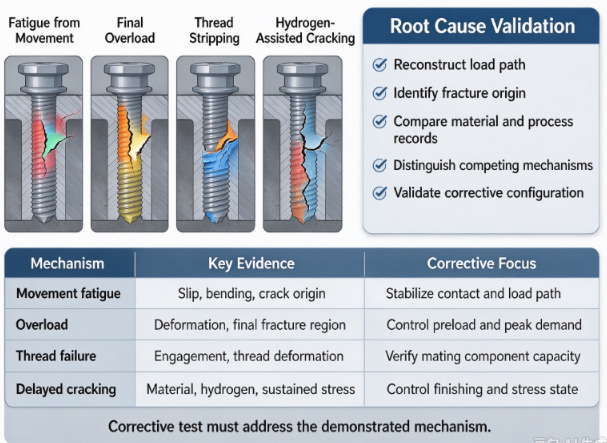
A movement-driven fatigue failure is classified as weak material. Lost compression allows the interface to slide and bend the bolt repeatedly, while the investigation examines only a material report. The replacement may fail through the same sequence. Prevention requires reconstructing the load path and examining contact movement, grip support, and fracture-origin evidence.
The final overload region is mistaken for the initiating event. A crack progressively reduces the effective section before a later load completes separation. The corrective action focuses on the final event rather than the earlier damage mechanism. Prevention requires staged fracture examination and correlation with operating and structural evidence.
Internal-thread damage is overlooked. Reduced engagement or a weak mating component deforms before the bolt fails, changing preload and alignment. Installing a new bolt leaves the limiting condition in place. Prevention requires preserving and assessing the actual mating thread, including effective engagement and representative capacity.
Removal torque is used to infer original preload. Corrosion, locking resistance, wear, and changed surface conditions alter the removal process. The inferred assembly state is unreliable. Prevention requires configuration-specific assembly correlation and evidence from the physical contact and process history.
Delayed cracking is attributed to a later operating shock without process review. A susceptible finished material and hydrogen exposure create cracking under sustained tension before the reported event. The finishing condition remains uncorrected. Prevention requires reviewing the material and process chain and conducting mechanism-relevant validation.
The investigation destroys its most useful evidence. Cleaning, forced fracture matching, or unrecorded disassembly alters origin features, contact patterns, or component positions. The cause becomes uncertain and corrective testing loses its reference. Prevention requires documented preservation and a planned sequence of nondestructive and destructive examinations.
Structural requirements
Define the intended load path, external load locations, fastener reactions, and relevant combined loading.
Verify actual grip geometry, bearing support, effective thread engagement, and bottom clearance.
Identify the mechanism established by the investigation and the variables controlling its recurrence.
Specify configuration-specific initial preload, retained condition, movement, and damage requirements.
Drive specifications
Define the assembly process, friction condition, tool configuration, and seating verification.
Require torque-force correlation for the actual finished components and approved reassembly state.
Preserve fault, interruption, recovery, and retightening records linked to the physical connection.
Define the response to damaged threads, abnormal seating, and uncertain prior assembly history.
Environmental requirements
Identify service exposure, corrosion condition, temperature history, and relevant sustained-load periods.
Require finished-material and surface-treatment evidence addressing the demonstrated cracking risk.
Define the preservation of fracture surfaces, corrosion products, contact marks, and retained fragments.
Safety standards and validation
Confirm the applicable examination and testing documents before specifying compliance or numerical limits.
Require the investigation report to distinguish observations, interpretations, and unresolved uncertainty.
Validate the corrective configuration using loading and conditioning relevant to the established mechanism.
Link specimens, material reports, finishing records, assembly data, and acceptance decisions through traceable identity.
The released specification should close the demonstrated failure path while preserving the connection's other required functions. A change that prevents bolt rupture but causes thread stripping, contact movement, or support damage is not an acceptable closure. The validation must evaluate the revised assembly as a complete mechanical system.
For Ningbo yi teng construction machinery CO,LTD, the bolts product page should identify the traceable finished-part evidence needed to support configuration-specific failure investigation and corrective validation.
I assess any manufacturer's ability to connect the actual part with its material, heat-treatment, finishing, dimensional, and assembly records. The engineering team should preserve specimens, explain examination limitations, and distinguish fastener defects from joint-induced loading. Useful capability also includes representative testing of mating components and revised configurations.
Certification scope and current status require verification before specification. A general quality-management record cannot establish the cause of a particular fracture. The meaningful evidence is a reviewable chain from the failed assembly to the supported mechanism and the validated corrective change.
Usually it cannot establish the complete failure sequence by itself. Fracture evidence must be combined with geometry, material condition, assembly history, and operating loads. Some observations support several competing mechanisms until additional examination distinguishes them.
Only after the required safety action and evidence-preservation plan have been established. Retightening changes the assembly state and can remove useful information. Their positions, condition, and relevant measurements should be documented before intervention where practicable.
Only when inadequate bolt capacity is the established mechanism and the complete revised joint is validated. Greater bolt capacity can transfer failure to the mating thread or structure. It does not remove movement, misalignment, or an uncontrolled finishing process.
No, elapsed time after installation is supporting context rather than a complete diagnosis. Material susceptibility, hydrogen exposure, tensile stress, and fracture evidence must be assessed together. Competing fatigue, overload, and environmental mechanisms also require consideration.
It must reproduce or adequately represent the mechanism and controlling conditions established by the investigation. Matching only the final broken condition is insufficient. Load path, origin location, contact behavior, and material state provide the necessary comparison.
Share your project parameters for a technical review.
Personne à contacter : Mme Wu
Téléphone :0086-13958324455
Service client : +86-0574 88065928
Courriel : Sales@zjbzj.com
Télécopie : +0086-0574 88065656

site officiel
Copyright @ Ningbo yi teng construction Machinery CO, LTD, principalement engagé dans la série de boulons de lame, les boulons hexagonaux et les dents de godet. Bienvenue à vous renseigner !
Plan du siteCe site Web utilise des cookies pour vous garantir la meilleure expérience sur notre site Web.
 English
 Español
 Portugues
 Pусский
 Deutsch
 日本語
 한국어
 العربية
 हिन्दी



 WhatsApp
 Téléphone
Commentaire
(0)